Moving & living guide · Germany
Indians in Berlin: the 2026 guide to Mitte, Charlottenburg, Lichtenberg, Kreuzberg, Neukölln, Adlershof and the rest of the city
On 30 June 2026 Berlin’s residents’ register counted 49,504 Indian citizens — the fourth-largest group of foreign nationals in the city after Turkey, Ukraine and Poland, and about 15% of all Indian citizens in Germany at the end of 2025 — with 5,025 more Germans whose origin region is India. They are a young community (90% are aged 15 to under 45) and live all over the city rather than on one street: Mitte has the most (8,315), then Charlottenburg-Wilmersdorf (5,216) and Lichtenberg (5,046). The Sri Ganesha Hindu Temple at Hasenheide 106 in Neukölln, consecrated in June 2026, is the main temple, with the ISKCON Jagannatha temple in Weißensee and a gurdwara in Teltow; groceries are scattered, with Spice Junction in Schöneberg, Anant in Neukölln and Zora at Kottbusser Tor among the shops confirmed. The practical fact to start with is the Anmeldung: you must register your address within 14 days at any Berlin Bürgeramt, and the bank account, tax ID and insurance follow from it.
About 311,000 Indian nationals live in Germany: 311,130 on 31 December 2025. That is a national figure, not one for Berlin alone. Source: Destatis, foreign population by citizenship (Central Register of Foreigners)
1.Berlin at a glance
Correct or addContents ↑Berlin is Germany's capital and its largest city. The residents' register counted 3,917,196 people with a main residence on 30 June 2026, 972,941 of them foreign nationals. Among those were 49,504 Indian citizens: 48,111 at the end of December 2025 and 49,504 six months later, which makes Indians the fourth-largest foreign group in the city, behind Turkey (107,051), Ukraine (75,868) and Poland (50,425) and ahead of Syria (40,662). That is the Amt für Statistik Berlin-Brandenburg's count of people who hold an Indian passport. It leaves out Germans of Indian origin: the same report lists another 5,025 German citizens with a migration background whose region of origin is India, so the register shows 54,529 residents with an Indian background in all.
Two features set Berlin's Indian population apart. It is young: 44,614 of the 49,504 (90%) are aged 15 to under 45, 1,399 are 45 to under 65 and only 149 are 65 or older. And it is more male than female: 31,723 men and 17,781 women (36%). Nationally, Destatis counted 311,130 Indian citizens in Germany on 31 December 2025, so Berlin's 48,111 on that day was about 15% of the total (the two figures come from different registers, so treat the share as approximate). The German-wide picture, with the Blue Card, the Chancenkarte and salaries, is in the jobs guide; this page is about Berlin.
| Essential (2026) | Where / what |
|---|---|
| Population | 3,917,196 residents with a main residence on 30 June 2026; 972,941 foreign nationals |
| Indian citizens | 49,504 on 30 June 2026 (48,111 on 31 December 2025); fourth-largest foreign group |
| Age and sex | 90% aged 15 to under 45; 36% women |
| Largest districts | Mitte 8,315; Charlottenburg-Wilmersdorf 5,216; Lichtenberg 5,046 |
| Rents | Mietspiegel 2026 median €7.71 per m² net cold; asking rents €14.63 per m² (Immowelt, October 2026); a room in a shared flat €600 warm (empirica, winter semester 2026/27) |
| Local transport | Single ticket Berlin AB €4.00 (120 minutes); Deutschlandticket €63 a month in 2026, €66.80 from 1 January 2027 |
| Registration | Anmeldung within 14 days of moving in; free; any Bürgeramt |
| Health cover | Statutory 14.6% shared with the employer plus the insurer's supplement (official 2026 average 2.9%); students about €141–146 a month at TK |
| Childcare | Kita free of charge apart from about €23 a month for meals (berlin.de) |
| Temples | Sri Ganesha Hindu Temple, Hasenheide 106 (Neukölln); ISKCON Jagannatha temple, Berliner Allee 209 (Weißensee); gurdwara, Bahnstraße 2, Teltow |
| Diwali 2026 | Sunday 8 November; events listed for Saturday 7 November at YAAM and at Jules B-Part |
| Embassy of India | Tiergartenstraße 17, 10785 Berlin; covers Berlin, Brandenburg, Mecklenburg-Vorpommern, Sachsen, Sachsen-Anhalt and Thüringen |
The national paperwork that follows an Indian to Germany is in the Germany topic guides: jobs, OCI card and passport renewal, with the temples and gurdwaras of Germany alongside. The Indians in Germany page gathers the events, groups and businesses across the country and links the city pages.
2.The community, and where it lives
Correct or addContents ↑Indians were organising in Berlin before India was independent. The Berlin Committee, later the Indian Independence Committee, was formed in 1914 by Indian students and activists in Germany, and the Free India Centre, the European branch of Subhas Chandra Bose's provisional government, was founded in 1942 and worked from Berlin. That history has little to do with today's community, which is overwhelmingly recent. The Amt für Statistik described the Indian group as growing steadily: the number rose by 4,027 in the first half of 2022, and in the first half of 2024 Indians made 3,863 new registrations, second only to Ukrainians. The pace has slowed since: the count went from 48,111 on 31 December 2025 to 49,504 on 30 June 2026, an increase of 1,393 (2.9%).
Who they are is easier to say from the age table than from any survey. Nine in ten are of working or student age, and the people who run the community's places say the same: the Sri Ganesha temple's site describes students and IT professionals newly arrived from India as one of the four groups it serves, and the Berlin gurdwara says its prayer house is a social meeting point for most newcomers from India, in particular students and qualified workers. The register does not publish Indians by state or mother tongue, so there is no honest Berlin breakdown to quote. What the organisations show is a mixture: a Bengali community with its own cultural association, a Hindu congregation worshipping in the Dravidian style at the new Neukölln temple, Sikh families around the Teltow gurdwara, and Tamil families with roots in Sri Lanka at the Murugan temple in Britz. Telugu, Malayali, Gujarati, Marathi and Kannada communities certainly live here too, but we could not find a Berlin association of each with a public page; the groups listed below are where they appear.
Indian citizens by district, 30 June 2026
| District | Indian citizens | Share of the 49,504 | Women |
|---|---|---|---|
| Mitte (with Tiergarten, Moabit, Wedding, Gesundbrunnen) | 8,315 | 16.8% | 2,715 (32.7%) |
| Charlottenburg-Wilmersdorf | 5,216 | 10.5% | 1,901 (36.4%) |
| Lichtenberg | 5,046 | 10.2% | 2,041 (40.4%) |
| Pankow | 4,425 | 8.9% | 1,636 (37.0%) |
| Friedrichshain-Kreuzberg | 4,279 | 8.6% | 1,354 (31.6%) |
| Tempelhof-Schöneberg | 4,097 | 8.3% | 1,435 (35.0%) |
| Treptow-Köpenick (with Adlershof) | 3,873 | 7.8% | 1,401 (36.2%) |
| Neukölln | 3,416 | 6.9% | 1,080 (31.6%) |
| Spandau | 3,200 | 6.5% | 1,282 (40.1%) |
| Reinickendorf | 2,764 | 5.6% | 1,051 (38.0%) |
| Steglitz-Zehlendorf | 2,692 | 5.4% | 1,059 (39.3%) |
| Marzahn-Hellersdorf | 2,181 | 4.4% | 826 (37.9%) |
What the table says
- Mitte is the centre of gravity, with one in six Indian citizens. It holds the Embassy at Tiergartenstraße 17, Humboldt-Universität, the Charité campuses in Mitte and Wedding and N26's headquarters. Indian citizens are a little under 6% of the district's 145,983 foreign residents, and Mitte had the highest share of foreign residents of any district in mid-2024 (37.4%).
- Charlottenburg-Wilmersdorf is second, with the Technische Universität: 3,315 men and 1,901 women among its Indian citizens.
- Lichtenberg is third, ahead of Pankow, Friedrichshain-Kreuzberg and Neukölln: the register shows more Indian citizens in Lichtenberg (5,046) than in Friedrichshain-Kreuzberg (4,279) or Neukölln (3,416). The register does not say why, and we do not guess.
- Treptow-Köpenick has 3,873, and it contains Adlershof, a science and technology park that also houses part of Humboldt-Universität and that says it holds 1,300 companies and 18 research institutions with around 29,600 employees and about 6,200 students.
- Spandau, Steglitz-Zehlendorf and Lichtenberg have the highest shares of women (40.1%, 39.3% and 40.4%), which may reflect more couples and families; Mitte, Neukölln and Friedrichshain-Kreuzberg are the most male, at 31–33% women. These are the register's numbers; it does not record households.
There is no single Indian neighbourhood in Berlin comparable to a Little India: the shops and restaurants named below are spread from Schöneberg and Neukölln to Prenzlauer Berg and Adlershof. The rule of thumb is to choose the district by where you work or study and how long the commute to it is, and then to look for a temple, a grocer and a Bürgeramt appointment near the same U-Bahn line.
3.Your first two weeks in Berlin
Correct or addContents ↑The national chain — visa, residence card, health insurance, tax ID, bank — is described in the jobs guide. This is the Berlin version, in the order that works here, with the offices and figures that are specific to the city.
- A short stay first, a lease later. Landlords want a registration, a salary slip and a credit report you do not yet have, and rental fraud aimed at people arriving from abroad is common (see renting). A furnished room or a sublet for a month lets you see districts in person. Look for adverts that say "Anmeldung möglich" and check the lease allows it: without a registration you cannot get a tax ID or open a high-street bank account.
- The Anmeldung. You must register a new main residence within 14 days of moving in, at a Bürgeramt; it is free and the confirmation (Meldebestätigung) is issued at the appointment. You need your passport and visa or residence card, the registration form signed by you, and the Wohnungsgeberbestätigung, the landlord's confirmation that you have moved in — a rental contract does not replace it. Book through service.berlin.de or the citizens' hotline 115. The service is available at all Berlin Bürgerämter, so search the whole city, not only your own district. The online registration needs a German or EU eID, so it is not available to most Indian citizens. The appointment has been the bottleneck: the Senate's own measure of requests met within 14 days stood at 48.5% in March 2023, 58.2% in March 2024 and 74.0% in March 2025, and on 15 May 2026 it announced that in March 2026, for the first time, every person who asked for an appointment within 14 days could statistically get one, after 100 new posts and four new offices. That is an average for one month, so book the day you have the landlord's form, not the week you need it.
- Health insurance, before the first working day. Employees choose a statutory insurer and give its name to the employer; students enrol with one too. Figures and the private-insurance rule are in health.
- The tax ID. After the Anmeldung the Federal Central Tax Office issues your eleven-digit Steuer-ID; it is sent by letter only and cannot be given out by phone, and your employer needs it to run payroll without emergency tax (class VI). If it has not arrived, ask the BZSt for it again by online form or letter.
- A bank account. Digital banks open an account on a passport before you have an address; the high-street banks want the Meldebestätigung. Your salary and a Deutschlandticket subscription both need a SEPA account.
- The residence permit at the Landesamt für Einwanderung (LEA). Berlin's immigration authority gives its postal address as Friedrich-Krause-Ufer 24, 13353 Berlin. The visa gets you in; within its validity you apply for the residence card. Applications for residence titles for employment, new and extended, have been online since 2 April 2025, for family reasons since 23 March 2026; an in-person appointment follows, with the originals, and the LEA says residence documents now use digital photos taken at the office (PointID), so check before paying for a studio photo. The LEA's site gives no waiting time, and our jobs guide warns that appointment queues in Berlin run to months, so apply on the first day you can and carry the Fiktionsbescheinigung if your visa runs out while you wait.
- A transport ticket. The Deutschlandticket (€63 in 2026) is a subscription; single tickets and the 4-trip card suit the first week. More in getting around.
- The broadcasting licence. The Rundfunkbeitrag is €18.36 a month per flat, however many people live in it, so a shared flat has one bill to split; expect a letter from the Beitragsservice after the Anmeldung.
- A German course. A first residence permit for employment gives a right to an integration course; the BAMF page explains how to find one, and the Welcome Centre Berlin offers free, multilingual counselling (its website is in English, German, Russian, Turkish and Arabic) on residence status, housing, health, work and school.
- The Indian paperwork. A passport due to expire, a child born in Berlin, an OCI after naturalisation: the Embassy at Tiergartenstraße 17 handles them by appointment, with no outsourcing centre since Alankit ended on 19 January 2026 — see the consulate section.
- One Sunday at a temple, a gurdwara or a WeDesi event. The Berlin groups on Namaste Community and the events page will give you a phone number for a landlord, an accountant and a doctor faster than any search.
4.Neighbourhoods and renting: the 2026 Mietspiegel, asking rents and the rules
Correct or addContents ↑Berlin has two rent figures and they are far apart. The first is what sitting tenants pay: the Senate's Mietspiegel 2026, presented at the end of May 2026, puts the median net cold rent at €7.71 per square metre, 50 cent more than the €7.21 of the 2024 edition, across roughly 1.6 million flats it covers; 29.4% of addresses are in a simple residential location, 49.9% in a middle one and 20.7% in a good one. The second is what a flat costs when you move in. Immowelt's October 2026 price map puts asking rents at €14.63 per m² net cold, against €11.19 in October 2021, so €1,000 of cold rent buys about 68.4 m² today against 89.4 m² five years ago. The Wohnmarktreport 2026 of Berlin Hyp and CBRE gives an average asking rent of €15.80 for 2025, with Mitte the dearest district at €20.01. The direction has stopped being up: the Greix index of the Kiel Institute found Berlin's asking rents 0.8% lower in the second quarter of 2026 than a year earlier, while Cologne rose 6.0%, Hamburg 5.1% and Munich 3.7%. Numbeo's contributors, updated on 22 October 2026, put a one-bedroom flat at €1,262.86 in the centre and €995.00 outside it, and a three-bedroom at €2,388.10 and €1,870.83.
For a student the number is the room. empirica's winter-semester 2026 survey, with data to 15 August, gives €600 a month warm as the standard price (the median of listings) for an unfurnished room of 10 to 30 m² in a shared flat in Berlin, level with Freiburg and below Munich (€790), Hamburg (€659), Cologne (€630) and Frankfurt (€620); the average for all university towns is €516. The survey covers unfurnished rooms; furnished rooms and sublets, which is what most newcomers find first, are not in it.
Choosing a district
- By workplace or university. Adlershof (Treptow-Köpenick) for the science park and the Humboldt-Universität natural-science campus; Charlottenburg for the Technische Universität; Dahlem (Steglitz-Zehlendorf) for the Freie Universität; Mitte for Humboldt-Universität, the Charité campuses and start-up offices such as N26's; Siemensstadt in Spandau, where Siemens's site is being rebuilt as the 76-hectare Siemensstadt Square.
- By temple. Neukölln for the Sri Ganesha temple, Britz for the Murugan temple, Weißensee (Pankow) for the ISKCON temple; the gurdwara is in Teltow, outside the city.
- By grocer. Schöneberg (Spice Junction), Neukölln (Anant), Kreuzberg (Zora) and Tiergarten (India Store); see groceries.
- By schools. The international schools are in the south-west: Berlin International School in Dahlem, the John F. Kennedy School in Zehlendorf and Berlin Brandenburg International School just over the boundary in Kleinmachnow.
- By cost. Mitte has the highest average asking rent of any district (€20.01 in 2025). The register gives numbers of Indian citizens by district but no rents, and we found no district-level rent table for 2026 that we could open, so compare listings street by street.
The rules that matter
- Mietpreisbremse. For contracts concluded since 1 June 2015, the rent at the start of a tenancy may not exceed the local comparable rent (the Mietspiegel) by more than 10%, with exceptions for flats first used and let after 1 October 2014 and for the first letting after comprehensive modernisation. The Bundestag extended the national rule to the end of 2029 in June 2025; Berlin's Senate designated the whole city a tight market by ordinance (the Senate's April 2025 ordinance ran to 31 December 2025), so ask the Mietpreisprüfstelle that the current ordinance applies before you rely on it. To recover an overpayment you must first object to the rent; for tenancies begun since 1 January 2019 a simple objection is enough.
- The deposit. The Kaution may not exceed three months' net cold rent (without service charges) and you may pay it in three equal monthly instalments. The landlord must keep it separately from their own money. A deposit demanded before you have seen the flat is the commonest sign of a scam.
- Brokers. A broker may charge a tenant only if the tenant commissioned the broker in text form; passing on the landlord's commission is void, and the fine can reach €25,000.
- The Wohnberechtigungsschein (WBS). A certificate of entitlement to a subsidised flat. A non-EU applicant needs a residence permit valid for at least one year, an intended stay of at least 11 months and an age of 18; Berlin's WBS 140 income limit is €16,800 a year for one person, and the certificate is usually valid for a year. Students and low-paid workers may qualify; most Blue Card holders will not.
- Subletting and WGs. Ask for the main landlord's written permission, and check that the sublease lets you register.
Scams to expect
A flat that cannot be visited, a landlord "abroad" who will post the keys, a deposit by transfer or voucher before a viewing, a "registration for sale". The jobs guide lists the pattern. Pay only after you have stood in the room and signed, and do not buy a registration: the Wohnungsgeberbestätigung is a statement that you have really moved in, and paying for a false one puts you and the seller at risk.
5.Getting around: BVG fares, the Deutschlandticket, student tickets and BER
Correct or addContents ↑Berlin's U-Bahn, S-Bahn, trams, buses and ferries share one fare system run by the Verkehrsverbund Berlin-Brandenburg (VBB), and the BVG sells most of the tickets. The city is zones A and B; the airport BER and towns such as Teltow lie in C. Fares rose on 1 January 2026 by about 6% on average, and some products were dropped.
| Berlin ticket (from 1 January 2026) | Price |
|---|---|
| Single ticket AB (120 minutes, one direction) | €4.00 |
| Short trip (Kurzstrecke) | €2.80 |
| 4-trip card AB | €12.40 (€3.10 a trip) |
| 24-hour ticket AB | €11.20 |
| Single ticket ABC (to BER, Teltow and other zone C towns) | €5.00 |
| Deutschlandticket (nationwide local and regional transport, monthly subscription) | €63 in 2026; €66.80 from 1 January 2027 |
| Berlin-Ticket S (monthly, AB, for people on benefits) | €27.50 |
What changed in 2026. The VBB stopped selling the 7-day ticket and annual tickets, and the 10 o'clock ticket in Berlin. For anyone who rides daily the Deutschlandticket is the benchmark, and Numbeo's "monthly pass" price for Berlin is the same €63: it is sold as a subscription, paid by direct debit (so you need a SEPA account), and if you buy after the 10th of a month you pay for that month and the next and can cancel only at the end of the following month. The price is fixed at €63 until 31 December 2026 and then rises to €66.80.
Students do not buy a monthly ticket at all. The Deutschlandsemesterticket is part of the semester fee: at Freie Universität Berlin the fee for the winter semester 2026/27 is €376.80, of which €226.80 is the ticket. Deutsche Bahn says the 2027 price rise does not affect the winter semester 2026/27 or the summer semester 2027.
Teltow and BER. The Berlin gurdwara is in Teltow, and the Wikipedia entry for Teltow Stadt station places it in VBB zone C, so an AB ticket is not valid for the whole trip; use an ABC single or the Deutschlandticket. The airport BER also lies in zone C, so it needs an ABC ticket or the Deutschlandticket. BER's published route list shows no nonstop flight to India that we could find, so the usual route home is a connection through Frankfurt, Munich, Istanbul or a Gulf hub; check the airlines' own schedules before you book.
Taxis. Numbeo's October 2026 contributors put a taxi start at €4.65 and €2.80 a kilometre, so the U-Bahn, S-Bahn and tram are the everyday choice.
6.Work and employers: start-ups, industry, science and the honest 2026 market
Correct or addContents ↑As the jobs guide puts it, Berlin is where the start-ups and the biggest English-speaking job market are, but 2026 is a cautious market. The national position is in the jobs guide: 2,994,000 registered unemployed in September 2026 (6.4%), 79,000 unfilled IT jobs according to Bitkom, and employers that still cannot fill them because applicants lack German. Berlin has done better than the country on postings: Indeed's economist reported in April 2026 that Berlin job postings had risen 7.7% since the end of September 2025 while the national figure fell 4.3%, with IT application, data and software postings up by double digits, and the tech share of Berlin postings back to 11.8% from 10% at the end of 2024 — but well below the 18% of the 2022 peak. She cautioned that the recovery is fragile.
Who hires
- Start-ups and scale-ups. Zalando, Delivery Hero and N26 are headquartered in Berlin (N26 SE at Voltairestraße 8, 10179 Berlin, according to its imprint). We found no published count of Indian employees at any of them, so we do not give one; check each company's careers page for the working language of the role.
- Industry. Siemens AG lists Berlin and Munich as its registered offices, and its historic site in Siemensstadt, in Spandau, is being redeveloped as the 76-hectare Siemensstadt Square, with around 3,750 flats planned by the 2030s. Deutsche Bahn's headquarters is the Bahntower at Potsdamer Platz.
- Science and health. The Charité has four campuses (Mitte, Virchow-Klinikum, Benjamin Franklin and Buch), Vivantes is the Land's hospital network, and Adlershof's technology park holds 1,300 companies and 18 research institutions with about 29,600 employees (the park's own figure, 23 March 2026). As the jobs guide notes, universities and research institutes are among the biggest English-speaking employers outside IT.
- The Indian IT companies. The jobs guide lists the Indian IT majors that run German offices, Berlin among them. They are a route in on an ICT card or a Blue Card issued through the German entity, not a Berlin specialism, and we found no published count of their Berlin staff.
The permits, in Berlin
The Blue Card thresholds for 2026 (€50,700, or €45,934.20 in shortage occupations and within three years of a degree), the Chancenkarte (a 12-month search permit with €13,092 in a blocked account) and the settlement clock are in the jobs guide. In Berlin the office is the Landesamt für Einwanderung, which has taken applications for employment titles online since 2 April 2025 and runs a Business Immigration Service for employers that includes the accelerated skilled-worker procedure; ask an employer whether it has used it. StepStone's 2026 report puts the median salary in Berlin at €56,500, below Munich (€64,750) and Frankfurt (€64,000); for a single person in tax class I, €60,000 gross is about €3,140 net a month after tax and social insurance.
Students and the first job
Of the 200,852 students at Berlin's higher-education institutions in the winter semester 2024/25, 49,801 were foreign. Nationally, India sends the largest foreign group at German universities (58,800 in the winter semester 2024/25, per the jobs guide); the Indian share in Berlin is not published. International students may work 140 full days or 280 half days a year, or 20 hours a week in term, so a Werkstudent job at the company you want to join is the standard way in, and the 18-month post-study permit lets you stay and look. The Welcome Centre Berlin and WeDesi, listed under associations, offer counselling and integration help to newcomers, expats and students.
7.What Berlin costs in 2026
Correct or addContents ↑For a room in a shared flat Berlin is cheaper than Munich, Hamburg, Cologne or Frankfurt (empirica, winter semester 2026/27); the dear items are rent and, for families who choose one, an international school. The table is Numbeo's Berlin page, updated on 22 October 2026 from 2,007 entries by 320 contributors in the past twelve months. It is crowd-sourced, so treat each line as an order of magnitude, but the rents and fares match the official figures in the sections above.
| Item (Numbeo, 22 October 2026) | Berlin |
|---|---|
| Inexpensive restaurant meal | €15.00 |
| Mid-range meal for two (three courses) | €70.00 |
| Milk, 1 litre | €1.11 |
| White rice, 1 kg | €2.96 |
| Chicken fillets, 1 kg | €10.71 |
| Eggs, dozen | €4.03 |
| Onions / tomatoes, 1 kg | €1.93 / €3.34 |
| Basic utilities, 85 m² flat | €344.61 a month |
| Mobile plan (10 GB or more) | €17.46 a month |
| Broadband (60 Mbps or more) | €43.32 a month |
| Gym membership | €35.31 a month |
| Cinema ticket | €13.00 |
| Private full-day preschool | €129.00 a month |
| International primary school, annual tuition | €14,158.00 |
| Monthly public-transport pass (regular price) | €63.00 |
| One-bedroom flat, centre / outside | €1,262.86 / €995.00 |
| Three-bedroom flat, centre / outside | €2,388.10 / €1,870.83 |
| Average monthly net salary | €3,133.91 |
Fixed costs that are not on the table
- The broadcasting licence: €18.36 a month per flat.
- Health insurance: for a salaried employee about 7.3% of gross plus half the insurer's supplement, up to the ceiling; for a student about €141 to €146 a month (see health).
- Residence-card fees: €100 for the card and €75 for the visa, per the jobs guide; Anmeldung is free.
- Semester fee: €376.80 at Freie Universität in winter 2026/27, including the €226.80 transport ticket; the university charges no tuition fees apart from continuing-education programmes.
A student's month, in arithmetic
A room at the €600 warm standard price plus statutory student insurance of about €146 comes to roughly €746 a month before food, a phone and books. The semester fee, which includes the transport ticket, is paid twice a year. That is arithmetic on the sources above, not a survey of what students spend.
Where the money goes in the first month
The cost of arriving is front-loaded: a short-term room or sublet, a deposit of up to three months' net cold rent (payable in three instalments), the €75 visa and €100 residence card, and the first insurance contribution before the first salary arrives. Against that, Kita tuition is free apart from meals, public schools charge no fees and a nationwide ticket costs €63 a month. Taxes and net pay for a full salary are in the jobs guide; groceries are in the table above, and the places that stock Indian staples are in groceries.
8.Health: statutory or private cover, students, emergencies and mental health
Correct or addContents ↑Every resident of Germany must have health insurance, and the choice made on the first day of work is the one that matters. Most residents are in the statutory scheme (gesetzliche Krankenversicherung, GKV); the private scheme (PKV) is open to employees above an income line and to some other groups, such as the self-employed.
Statutory cover in 2026
- The rate. The general contribution rate is 14.6% of gross salary, split equally between employee and employer, plus an insurer-specific supplement (Zusatzbeitrag), also shared equally. The Federal Ministry of Health set the official average supplement for 2026 at 2.9%; each insurer sets its own, so compare them. Long-term care insurance is on top.
- The ceiling. Contributions are calculated on income up to €69,750 a year (€5,812.50 a month); salary above that line is not charged.
- The switching line. An employee can leave the statutory scheme for a private insurer only above €77,400 a year (€6,450 a month). Think twice if you have a family: statutory cover includes a non-working spouse and children at no extra charge, while private premiums are set per person and are hard to leave.
- Choosing an insurer. AOK, TK, Barmer, hkk and others compete on the supplement and on service; your insurer sends the electronic health card.
Students
Students in the statutory scheme pay a flat rate fixed to the BAföG need rate. For 2026 the health contribution is 10.22% of it, €87.38, plus the insurer's supplement; at the TK, with a 2.69% supplement (€23.00), the totals are €141.16 a month under 23 or with a child and €146.29 for a childless student of 23 or older, because long-term care is 3.6% or 4.2%.
Finding a doctor
Register with a family doctor (Hausarzt) near your address and bring your health card. The 116117 patient service lists out-of-hours practices (Bereitschaftspraxen), runs an appointment service for doctors and psychotherapists and has an English page, which is where to start if a specialist has no free slot.
Emergencies
112 is the fire and ambulance number across Europe, 110 the police. The Charité (Charitéplatz 1, 10117 Berlin, +49 30 450-50) runs four campuses, in Mitte, Wedding (Virchow-Klinikum), Steglitz (Benjamin Franklin) and Buch, and Vivantes is the Land's hospital network; both have an emergency section on their sites.
Mental health
Loneliness and money worry hit people who arrive alone in their first winter. The Berliner Krisendienst gives free, confidential help in psychosocial crises, 24 hours a day, by phone, in person and, on request, anonymously, at nine locations across the city; its website comes in eleven languages. The TelefonSeelsorge (0800 111 0 111, 0800 111 0 222 or 116 123) is free from anywhere in Germany. The temples and the gurdwara, and the groups below, are also places where someone will ask how you are.
9.Schools, Kitas, Willkommensklassen and the universities
Correct or addContents ↑Public schools in Berlin are free of charge, and the city's rules for children who arrive without German are written down. Four pieces matter for an Indian family: the Kita, the neighbourhood school, the Willkommensklasse and, for some, an international school.
Kita: free tuition, a place to find
Kita care in Berlin has been free of charge since August 2018, apart from a meal contribution of €23 a month (the Senate's Kita page); Kitas may ask up to €100 extra for things such as organic food, sport or language classes. A child is entitled to a place from the first birthday, for up to seven hours a day without a needs check; longer care needs proof that you cannot provide it yourself, such as an employer's confirmation. You apply for the Kita-Gutschein (the voucher) at the Jugendamt of the district where you are registered, even if the Kita you want is in another district, no earlier than nine months and no later than two months before the start date, and search for places in the free Kita-Navigator. The Senate said a Kita-Gutschein portal was expected from September 2026, so check on the ServicePortal Berlin whether it is live, and apply as soon as you have an address.
School: compulsory from six, free to attend
Schooling is compulsory from the age of six and public schools charge no fees. Willkommensklassen are small groups for newly arrived children who do not yet speak German. Children aged about eight and over usually start there, while six- and seven-year-olds go straight into the first two grades. Contact the Koordinierungsstelle of your district's Schulamt, which advises, assigns the school and class and gives you the documents to bring (identity papers, the registration certificate and school certificates; at the school, your child's birth certificate too). A child usually stays in a Willkommensklasse for no more than a year, with progress reports instead of marks until the move into a regular class, and joins art, music and sport lessons early. Register the week you have your Meldebestätigung. Most subjects are taught in German.
International schools
Parents who plan a short stay or want English-medium schooling look at the international schools. Berlin International School (Lentzeallee 8/14, 14195 Berlin, in the south-west) says it has more than 70 nations among its pupils, teaches in English and German and leads to the IB Diploma. The John F. Kennedy School (Teltower Damm 87–93, 14167 Berlin) is a German-American public school with 1,600 or more pupils from entrance class to grade 12 and a bicultural, bilingual curriculum. Berlin Brandenburg International School is at Schopfheimer Allee 10, 14532 Kleinmachnow, just over the city boundary. Numbeo's contributors put annual tuition for an international primary school in Berlin at €14,158; fees vary widely by school and grade, so ask for the current schedule.
Universities
Berlin's universities include Freie Universität in Dahlem, Humboldt-Universität in Mitte, Technische Universität in Charlottenburg, the Charité, the arts universities and several universities of applied sciences. The winter semester 2024/25 had 200,852 students, 49,801 of them foreign (Statistik Berlin-Brandenburg). Freie Universität says it charges no tuition fees apart from continuing-education programmes; its semester fee is €376.80 for winter 2026/27, with €226.80 of it the transport ticket. Check each programme's own page for English-taught courses and deadlines, and the German-language rules in the jobs guide.
10.Indian groceries, sweets and where to eat
Correct or addContents ↑We found no Indian shopping street in Berlin comparable to a Little India. The Indian grocers and restaurants we could confirm are spread across the city, which suits a population of 49,504 living in every district, and the list changes quickly: check hours before you travel. Rice and lentils are easy to find in any supermarket; the specialists are for spices, pickles, fresh produce, sweets and the ingredients a mainstream shop does not stock.
Groceries
- Spice Junction, Bülowstraße 44, 10783 Berlin (Schöneberg). Its site describes it as a one-stop Indian grocery store, retail and wholesale. The Berliner reported in May 2024 that it opened in December 2023, stocks spices, pickles, rice, frozen goods and fresh produce such as okra and mini aubergines, brings in Alphonso, Badami and Kesar mangoes from April to mid-July and runs a snack bar of vegetarian street food, mainly on Saturdays.
- Anant Supermarkt, Anzengruberstraße 20, 12043 Berlin (Neukölln). Indian, Asian and Afro groceries, with online ordering, according to its site.
- Zora, Kottbusser Damm 93, 10967 Berlin, by Kottbusser Tor. The Local's guide to Berlin's international supermarkets singled out its Indian and African cooking basics, fresh vegetables such as okra and karela, and fresh Indian sweets.
- India Store, Potsdamer Straße 100, 10785 Berlin. Its shop is open Monday to Saturday 11:00 to 20:00, and it also sells online, with shipping.
- Along Frankfurter Allee (Friedrichshain and Lichtenberg) OpenStreetMap lists South Asian shops such as Go India (no. 95) and Bangla Bazar (no. 266); we could not open a site of their own, so confirm before you go. In Gesundbrunnen it lists Punjab Supermarkt at Drontheimer Straße 32.
- Charlottenburg and Wilmersdorf. We could not confirm an Indian grocer in either; the nearest confirmed are Spice Junction and India Store.
Where to eat
| Area | Place | Notes |
|---|---|---|
| Kreuzberg | Delhi 6, Friedrichstraße 237 | North Indian; its site says it is in Kreuzberg near Mitte |
| Kreuzberg, Mitte, Schöneberg, Potsdamer Platz | Amrit | A group that says it has served Indian food in Berlin since 1996, now at four sites; its office is at Oranienburger Straße 45 |
| Mitte | Kailash Parbat, Friedrichstraße 134 | A purely vegetarian restaurant, open daily 11:30 to 22:30 |
| Mitte | Anjappar, Zimmerstraße 92 | Chettinad cooking |
| Mitte | India Club, Behrenstraße 72 (Adlon Palais) | North Indian fine dining, open 17:00 to 23:30, closed Tuesdays as of 1 January 2026; it says it was the first Indian restaurant in Germany recognised by the Michelin guide |
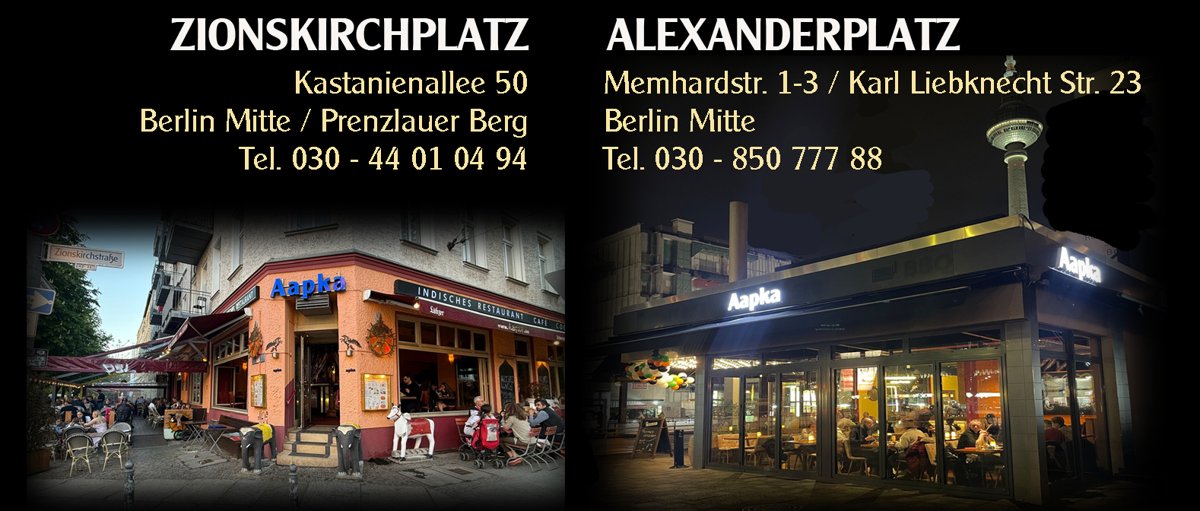
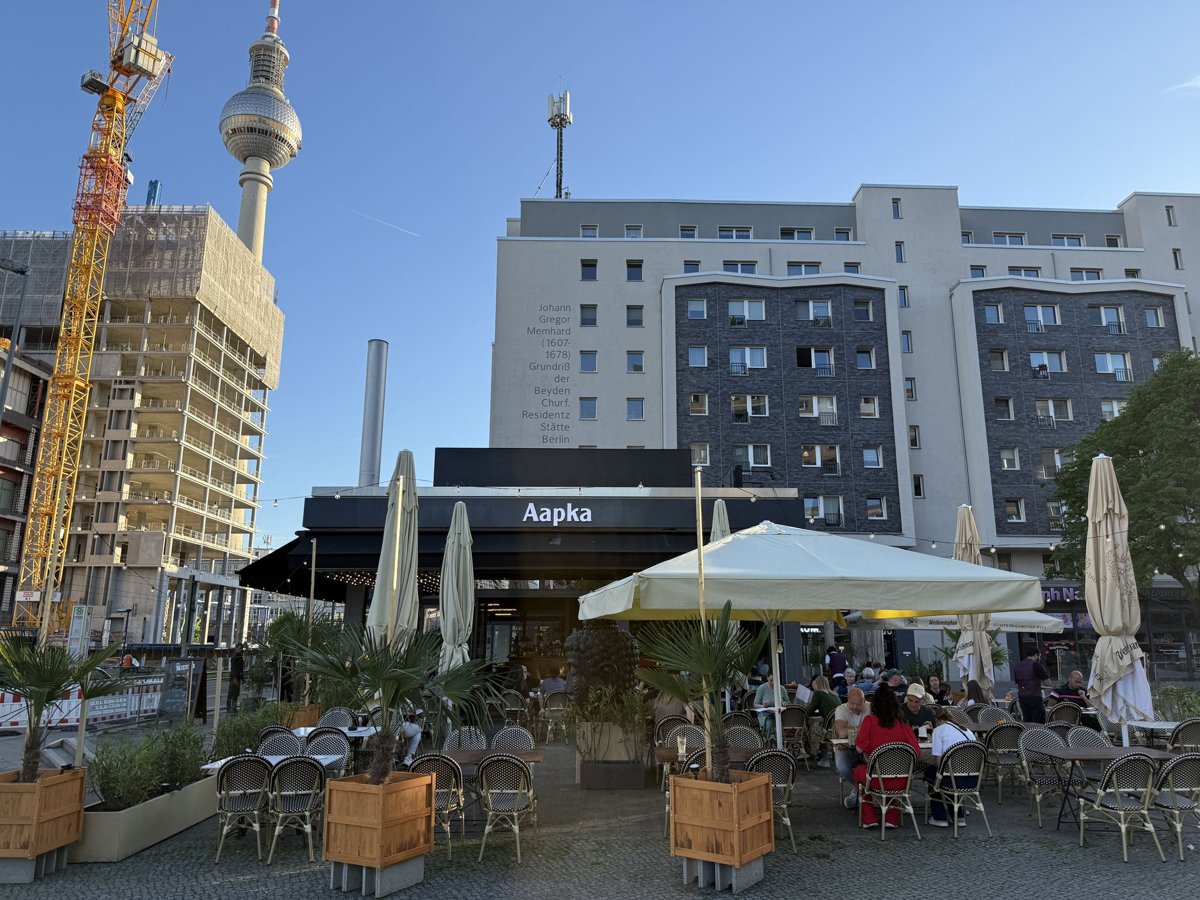
| Mitte and Prenzlauer Berg | Aapka, Kastanienallee 50 and Karl-Liebknecht-Straße 23 | Two sites, one near Alexanderplatz |
| Prenzlauer Berg, Neukölln | Chutnify, Sredzkistraße 43, and a second branch at Pflügerstraße 23 | South Indian street food; the first address is on its site |
| Tiergarten | Saravanaa Bhavan, Potsdamer Platz 5 | South Indian |
| Neukölln | Amba, Hermannstraße 93 | Its site gives the address and says it serves traditional dishes |
| Adlershof | Doon, Weerthstraße 10 | Open daily 12:00 to 23:00 |
Kailash Parbat is purely vegetarian; the gurdwara serves lunch at weekends and the ISKCON temple a Saturday feast. If your favourite thali house or grocer is missing, add it to the directory for Germany, which lists the businesses near each city, and the nearest ones are shown below.
In the directory in Berlin
The directory →Aa Markt | Best Pakistani, Indian, African, Arabic & Turkish Store In Berlin
Grocery Stores · Berlin
Aahaa
Restaurants · Berlin
Aanjal
Restaurants · Berlin
Aao Ji Restaurant
Restaurants · Berlin
Aapka
Restaurants · Berlin
Aapka
Restaurants · Berlin
11.Temples, the gurdwara and other places of worship
Correct or addContents ↑Berlin's first permanent Hindu temple in the Dravidian style was consecrated in Neukölln in June 2026. The addresses and hours here agree with the temples and gurdwaras page for Germany, which has the full list; times change on festival days, so check the temple's own site before a first visit.
| Place | Address | What to know |
|---|---|---|
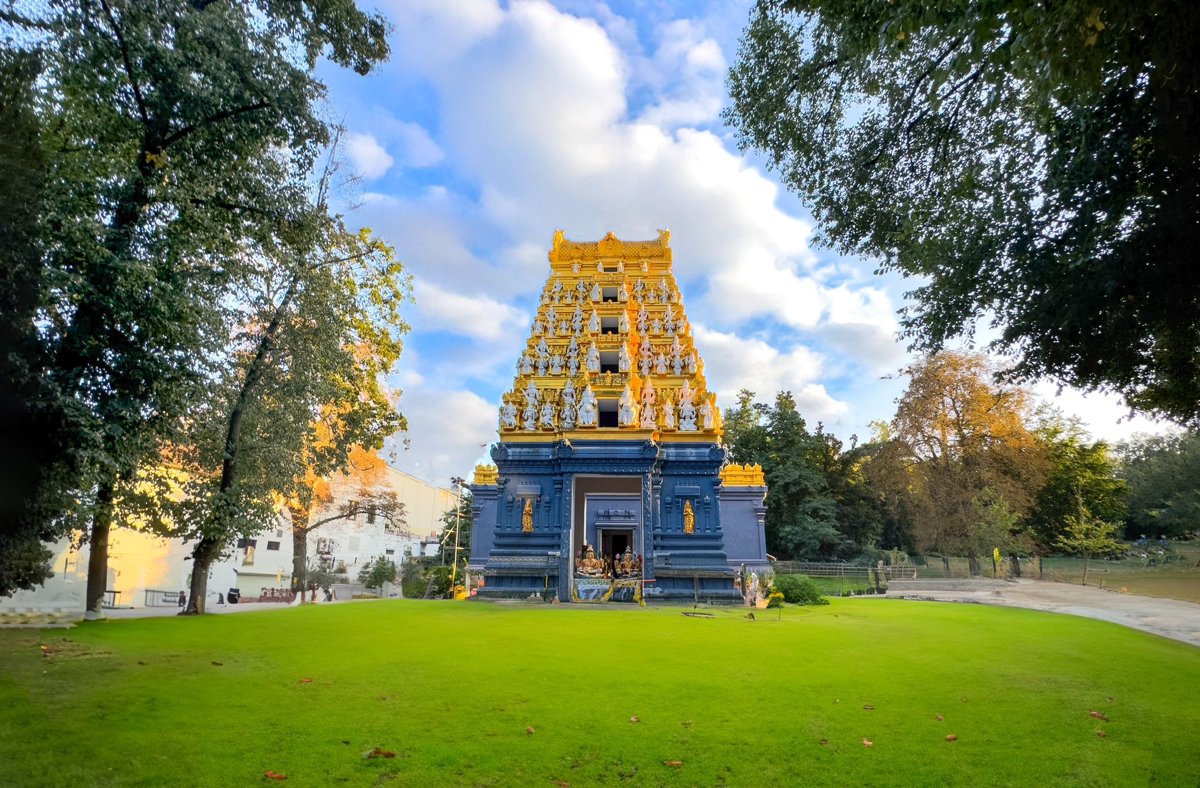
| Sri Ganesha Hindu Temple Berlin | Hasenheide 106, 10967 Berlin (Neukölln) | Berlin's first permanent Hindu temple in the Dravidian style, consecrated with the Maha Kumbhabhishekam on 3–7 June 2026; open daily 09:00–12:00 and 16:00–19:00 (can differ on festival days), aarti daily at 16:00; sanskara ceremonies; the registered association dates from 24 September 2005. The temple lists Hermannplatz (U7), Schönleinstraße (U8) and bus 171 |
| Sri Mayurapathy Murugan Temple | Blaschkoallee 48, 12347 Berlin (Britz) | A Tamil Saiva temple consecrated in 2013, mostly visited by worshippers with roots in Sri Lanka; its annual festival is the busiest time; no timetable published online |
| Jagannatha-Tempel Berlin (ISKCON) | Berliner Allee 209, 13088 Berlin (Weißensee) | Wednesday 18:30–20:00; Saturday 07:30–10:00 and 14:00–18:00 (darshan until 17:00, feast from 14:00 with kirtan); Sunday 07:30–10:00. Its site lists Dipavali (Diwali) on 8 November and Govardhana Puja on 10 November at 15:00 |
| Gurdwara Sri Guru Singh Sabha Berlin | Bahnstraße 2, 14513 Teltow (Brandenburg) | Services every morning and evening; the main diwan is on Sundays, about 10:00–16:00; visitors are always offered tea and a snack, and weekend lunch is served for up to 800 people |
| Vedanta-Gesellschaft Berlin | Marienfelder Allee 73, 12277 Berlin | A registered non-profit society with an ashrama; pujas are by registration only |
Notes
The Sri Ganesha temple is the one to start with: its site says it receives Hindu families from Berlin, students and IT professionals new from India, interfaith couples and neighbours, and it held Ganeshotsav on 14–26 September 2026.
The gurdwara has been in Teltow since 2021, after a former paint factory in Reinickendorf served as the gurdwara from 2002. The association has been a recognised non-profit since 1993, and its site says it works with other religious groups and takes part in Berlin's Forum of Religions and the Long Night of Religions. A single AB ticket does not reach it (see getting around). Its site calls it a meeting point for newcomers from India, students and qualified workers among them.
The Vedanta-Gesellschaft in Marienfelde publishes a 2026 puja calendar: a Ganesha puja on 19 September, a Durga Puja on Sunday 18 October (registration had closed when we checked) and a Kali Puja on Sunday 8 November at 18:00, for which registration by email is required and a confirmation must be shown at the door. The Balinese Hindu temple in the Gärten der Welt is a heritage pavilion, not a place of everyday worship, and is not listed. For Muslim, Christian and Jain families we could not confirm a Berlin address in an Indian-language community, so ask in the groups; the nearest-places list below shows what is close to you.
Every temple and gurdwara in Germany, with addresses and hours →
Hindu temples and gurdwaras near Berlin
From the Namaste Community directory, nearest to the centre first.
Sri Ganesha Hindu Tempel
Temples & gurdwaras · Berlin
Shiva-Ganesha-Tempel
Temples & gurdwaras · Berlin
Jagannatha Tempel Berlin
Temples & gurdwaras · Berlin
Sri Mayurapathy Murugan Tempel
Temples & gurdwaras · Berlin
Vedanta-Gesellschaft
Temples & gurdwaras · Berlin
Pura Tri Hita Karana
Temples & gurdwaras · Berlin
12.Associations, students, cricket and classes
Correct or addContents ↑A handful of names carry most of the Indian calendar in Berlin. The ones below are those we could confirm.
The Embassy's cultural wing
The Tagore Centre is the cultural wing of the Embassy of India in Berlin, with an auditorium in Tiergarten and a programme that its organiser page describes as running from classical and fusion concerts to dance, theatre, yoga and wellness workshops, language classes, exhibitions and film screenings. When we opened the Embassy's own events page on 23 October it showed no current programme, so ask the Embassy (+49 30 25795-0) or follow the Centre's listings.
Community organisers
- WeDesi describes itself as a Berlin collective of Indian events and runs the Holi in Berlin festival (the third edition was on 7 March 2026 at Jules B-Part, with food stalls and a desi flea market) and the Diwali in Berlin day in November. It also offers integration help and digital support for expats and students, according to its site.
- Namaste Berlin e.V. organised the Sarbojonin Durga Puja on 16–20 October 2026 at Waterloo-Ufer in Kreuzberg, according to The Local's festival guide of 16 October.
- Berliner Bengalis e.V. is a cultural association that promotes Bengali culture and Hindu traditions in the capital.
- The Ganeshotsav Berlin committee organises the September festival with the Sri Ganesha temple.
Cricket
Cricket is played in Berlin in clubs under the regional Ostdeutscher Cricket Verband, part of the German Cricket Federation. The federation's club list includes TSV GutsMuths 1861 (Wullenweberstraße 15), the Internationale Cricket Akademie Berlin, Berlin Eagles Cricket Club, Berlin Cricket Club and Berlin Cricket Academy. The list is undated, so contact a club to ask whether it takes new players this season.
Students
International students at the Freie Universität, Humboldt-Universität, the Technische Universität and the universities of applied sciences can find student groups through each university's students' union (ASta) and international office. We did not find a published list of Indian student associations in Berlin, so ask your faculty and the groups below.
Classes and ceremonies
The Sri Ganesha temple runs workshops during Ganeshotsav on yoga, mantras, cuisine, language and ritual studies, and evening performances of Bharatanatyam, Kathak, classical singing and the mridangam. Temple pujas, naming ceremonies and weddings are arranged through the temples themselves. For German itself, the BAMF integration courses and the Berufssprachkurse in the jobs guide are the first stop.
13.The festival year in Berlin, 2026
Correct or addContents ↑Berlin's Indian festivals are community-organised, held in clubs, halls and temple courtyards, and they cluster around Holi in March, Ganeshotsav in September, Durga Puja in October and Diwali in November. Diwali itself, Sunday 8 November 2026, is not a public holiday in any German state. What follows is what the organisers had listed on 23 October; the Berlin events page and the live listings under this section carry what is added later, and the Diwali page for Berlin gathers Diwali events in one place.
| Festival | When (2026) | Where | Organiser |
|---|---|---|---|
| Holi in Berlin (third edition) | Saturday 7 March, 12:00–22:30 | Jules B-Part, Luckenwalder Straße 6b | WeDesi |
| Ganeshotsav Berlin | 14–26 September, procession on 26 September | Sri Ganesha Hindu Temple, Hasenheide 106 | The temple and the Ganeshotsav Berlin committee |
| Durga Puja | 16–20 October | Waterloo-Ufer, Kreuzberg | Namaste Berlin e.V. |
| Durga Puja at the Vedanta-Gesellschaft | Sunday 18 October (registration closed) | Marienfelder Allee 73 | Vedanta-Gesellschaft Berlin |
| Wedesi Fridays, Diwali Night Edition | 6–7 November (listed) | MAAYA GmbH, Revaler Straße 99 | WeDesi |
| Diwali at MAGICUM | 6–10 November, 11:00 each day | MAGICUM Berlin Magic Museum, Große Hamburger Straße 17 | The museum |
| Diwali in Berlin | Saturday 7 November, 12:00–23:00 | Jules B-Part, Luckenwalder Straße 6b | WeDesi |
| Diwali Indian Street Food Festival | Saturday 7 November, 12:00–22:00 | YAAM, An der Schillingbrücke 3 | BreakFree Berlin |
| BHB Diwali Party | 7–8 November | Nights Events Berlin, Schönhauser Allee 36 | Bollywood House Berlin |
| Diwali | Sunday 8 November | Lakshmi Puja at home and at the temples | — |
| Kali Puja | Sunday 8 November, 18:00 (registration needed) | Vedanta-Gesellschaft, Marienfelder Allee 73 | Vedanta-Gesellschaft Berlin |
| Govardhana Puja | Tuesday 10 November, 15:00 | ISKCON Jagannatha temple, Berliner Allee 209 | ISKCON Berlin |
Diwali in Berlin, explained
The big public day is the Saturday before Diwali, 7 November. WeDesi's Diwali in Berlin is listed for 12:00 to 23:00 at Jules B-Part, beside Gleisdreieck on the Kreuzberg-Schöneberg border; its site says its Diwali draws more than 4,000 visitors, with over 15 artists and more than 20 food stalls. On the same afternoon the Diwali Indian Street Food Festival is listed at YAAM on the Spree, 12:00 to 22:00, billed as music, culture and a bonfire. The organisers' Eventbrite pages carry the listings; YAAM's own calendar did not show the festival on 23 October, so confirm tickets and times with the organiser. On Diwali itself the temples hold Lakshmi Puja: the ISKCON temple's site lists Dipavali on 8 November, and the Vedanta-Gesellschaft holds its Kali Puja that evening. The ISKCON temple follows with Govardhana Puja on 10 November.
Fireworks. The usual German rule applies: consumer fireworks are sold only in the last days of December and may be set off only around New Year's Eve, so Diwali is lit with diyas, candles and sparklers.
Coming up in Berlin
Every event →- NOV17
Let's Learn Hindi Berlin: Beginners - Free Online Demo class
Tue, 17 Nov 2026, 17:30–18:00
On-line
📚 Education - NOV19
THE WISDOM CLUB – Kirtan, Practical Wisdom & Soul Food
Thu, 19 Nov 2026, 19:00–20:15
Vana Mali
🙏 Religious€10.00 - NOV20
Girls’ dinner club
Fri, 20 Nov 2026, 18:15
Gagan fusion kitchen
🍛 Food & Drink€5.00 - NOV20
Wedesi Fridays - Retro Bollywood Edition
Fri, 20 Nov 2026, 23:00 – Sat 04:00
The Cloud Alexanderplatz
🎵 Music€2.23 - NOV21
Gujarati Nutan Varsh Sneh Milan 2026
Sat, 21 Nov 2026, 17:00–22:00
Shri Ganesha Hindu Temple
🎭 Cultural - NOV21
The Kirtan Family Band
Sat, 21 Nov 2026, 19:00–22:00
SHA-LA Studios Waterfront
🎵 Music€27.82


14.WhatsApp groups, and finding your people on Namaste Community
Correct or addContents ↑Indian Berlin runs on WhatsApp groups, as in every city: one for each university and intake, for the flat hunt, for the Anmeldung queue, for cricket, for a temple's volunteers and for the regional associations. Invitation links pass from person to person and go stale. This guide does not pretend the groups are unnecessary; it points to what they are good at and where they fail.
What the groups are good at, and what they are not
They are fast. Ask at nine in the evening which Bürgeramt had a free slot, or which landlord signed the Wohnungsgeberbestätigung without a fight, and someone answers. But you need an invitation to get in, the invitations are often expired, and the live ones carry the offers you should refuse: a "registration for sale", a sublet with a deposit demanded before a viewing, an "agent" selling visa appointments. A group of a thousand members has nobody checking who joined, every member sees your phone number, and the same Anmeldung and health-insurance questions come up every term and scroll away. A group does not know where you live, so a room in Spandau and a Durga Puja volunteer call in Kreuzberg arrive with the same weight.
What Namaste Community offers
Namaste Community is a community platform for Indians abroad, on the web and as an app. The app has local groups, events near you, a directory and Ask, where members answer each other's questions, and an anonymous mode exists. For Berlin: - the local groups are listed at /groups/in/germany/berlin, with the ones near Berlin shown under this section; - the events near you — Diwali nights, temple programmes, WeDesi days — are on the Berlin events page; - the directory for Germany lists the grocers, restaurants, temples and services, and businesses can add themselves; - in Ask, people who have been through the Anmeldung or the LEA queue answer questions.
Your first week, practically
- Find the group for your district or language on the Berlin groups page and read before you post; the Anmeldung and insurance questions are usually answered.
- Pick one event in the next fortnight from the events page — a temple programme, a WeDesi day, a cricket match. It is the fastest way from "the Indian community in Berlin" as a phrase to three people whose names you know.
- Ask the question you actually have and say where you live: the answer for Adlershof and for Wedding is rarely the same.
- Never send a deposit, a passport scan or a fee to someone you met in a group without meeting them and checking who they are.
- When you have found your flat, your doctor and your grocer, leave an answer for the next person from Hyderabad, Pune or Chennai.
If the group you need does not exist yet — Kannada parents in Pankow, a Telugu cricket team, Malayali nurses at the Charité — start it, so the next person searching finds it.
Groups in Berlin
All groups →🇩🇪 Germany-wide
For Indians and expats living in Germany.
90 members
15.Pakistani, Bangladeshi, Sri Lankan, Nepali and Afghan neighbours in Berlin
Correct or addContents ↑Indian life in Berlin is shared with the other South Asian communities of the city, in the same districts, universities and restaurants. Everything about renting, registering, insurance and schools in this guide applies to them as well; the differences are the embassy, the festival calendar and the aisle in the supermarket. The register's counts of foreign nationals on 30 June 2026 put them in proportion:
| Citizenship | Residents | Aged 15 to under 45 | Women |
|---|---|---|---|
| Afghanistan | 24,786 | 16,329 (66%) | 9,201 (37%) |
| India | 49,504 | 44,614 (90%) | 17,781 (36%) |
| Pakistan | 9,730 | 7,443 (76%) | 3,498 (36%) |
| Bangladesh | 3,581 | 2,744 (77%) | 1,297 (36%) |
| Nepal | 1,473 | 1,368 (93%) | 623 (42%) |
| Sri Lanka | 1,396 | 697 (50%) | 705 (50.5%) |
Pakistani and Bangladeshi
There are about one Pakistani citizen for every five Indian citizens in Berlin, and about one Bangladeshi for every fourteen. Urdu, Punjabi and Hindi are shared across the border. OpenStreetMap lists several restaurants described as Pakistani or Indian in Gesundbrunnen, Wedding and Neukölln, and the shops named in groceries on Frankfurter Allee and in Gesundbrunnen are South Asian rather than strictly Indian. Pakistan's Independence Day, on 14 August, falls the day before India's.
Sri Lankan and Tamil
The Sri Lankan population is small and the oldest of the group: only half of the 1,396 are aged 15 to under 45, 408 are 45 to under 65, 197 are 65 or older, and women are a majority. The Sri Mayurapathy Murugan Temple in Britz, consecrated in 2013, is visited mostly by worshippers with roots in Sri Lanka.
Nepali
Nepalis are the youngest of the group (93% aged 15 to under 45) and 42% women, which fits students and early-career workers. Nepali and Tibetan restaurants appear in Prenzlauer Berg, Friedrichshain and Schöneberg on OpenStreetMap. Tihar, the Nepali festival of lights, falls around Diwali.
Afghan Hindus and Sikhs
Berlin's Afghan population is large (24,786), and Afghan Hindus have founded mandirs in Hamburg, Cologne, Essen and Frankfurt; we could not confirm an Afghan Hindu temple in Berlin. The temples and gurdwara listed above welcome everyone.
Shared ground
Cricket clubs, the Tagore Centre's concerts, WeDesi's festivals and Berlin's interfaith events, in which the Teltow gurdwara takes part, are where the communities meet. Everything in the renting, health and safety sections applies to a Pakistani, Bangladeshi, Nepali or Sri Lankan newcomer in the same way; only the embassy and the festival calendar differ.
16.The Indian Embassy, help lines and staying safe
Correct or addContents ↑The Embassy of India in Berlin
Berlin is the only mission in Germany that is an embassy, not a consulate general. It is at Tiergartenstraße 17, 10785 Berlin, phone +49 30 25795-0. Its working hours are 09:00 to 17:30, Monday to Friday, with consular document submission 09:30 to 12:30 and collection 16:00 to 17:00. Berlin covers the Bundesländer Berlin, Brandenburg, Mecklenburg-Vorpommern, Sachsen, Sachsen-Anhalt and Thüringen; a Leipzig or Dresden address goes to Berlin, while Cologne, Düsseldorf and Dortmund go to Frankfurt, and Stuttgart and Munich to the consulate in Munich. The test is the address on your Meldebescheinigung.
Applications are taken by appointment, directly by the Embassy. The outsourcing firm Alankit stopped providing consular services on 19 January 2026, and the Embassy's appointment page says all consular services are handled by its Consular Section at Tiergartenstraße 17. Appointments can be booked up to six weeks ahead on the Embassy's site; if you cancel twice in one week you are blocked from booking for two weeks. Payments are accepted only in exact cash, and a return envelope must be a pre-paid C5 tracked one if you want documents posted. The full process is in the passport renewal guide and the OCI card guide. The missions have warned of callers posing as Embassy staff and demanding money; hang up and write to the mission.
After you have the new passport, your residence card must be re-issued with the new number (€67 for an adult): a Berlin Bürgeramt does it by appointment if the permit was issued by the LEA, as the passport-renewal guide explains.
Help lines
- 112 for fire and ambulance, 110 for the police.
- 116117 for out-of-hours doctors and the appointment service.
- Berliner Krisendienst for psychosocial crises, free and open 24 hours (see health); TelefonSeelsorge on 0800 111 0 111 or 116 123.
- ReachOut Berlin (Heinrich-Heine-Straße 15, 10179 Berlin, 030 69 56 83 39) offers counselling for victims of racist and right-wing violence.
- ADNB of the TBB, the anti-discrimination network, and the Senate's anti-discrimination office, which also hosts the Ombudsstelle under Berlin's Landesantidiskriminierungsgesetz, take complaints about discrimination by authorities and in the housing market.
- Willkommenszentrum Berlin for free counselling in several languages on residence, housing, health, work and school.
Safety, honestly
Berlin is a large capital and has the theft and pickpocketing that come with one. ReachOut Berlin keeps a record of racist and right-wing attacks in the city and counsels the people affected, and the anti-discrimination services above take complaints. The dangers that most often cost Indian newcomers money are three: - Housing and registration scams, described in renting. - Job and "agent" fraud. Nobody can sell you a German job, a Chancenkarte or a visa appointment; the jobs guide sets out the rules and where to report. - Fake Embassy calls threatening cancellation of your passport or deportation unless you transfer money. The missions say no such calls are made.
The weather, and what to read next
Berlin winters are grey and short on daylight: the sun sets before 16:00 around the solstice. Buy a proper coat and boots in October. The Germany guides cover the national rules: jobs, OCI, passport renewal and temples. The businesses near you are in the directory for Germany, and the Berlin events and groups pages are linked above.
Questions people ask
- How many Indians live in Berlin?
- The Amt für Statistik Berlin-Brandenburg counted 49,504 Indian citizens with a main residence in Berlin on 30 June 2026 (48,111 on 31 December 2025), the fourth-largest foreign group after Turkey, Ukraine and Poland. 90% are aged 15 to under 45 and 36% are women. The same report lists another 5,025 Germans with a migration background whose region of origin is India, so 54,529 residents have an Indian background in total. For Germany as a whole, Destatis counted 311,130 Indian citizens on 31 December 2025.
- Where do most Indians live in Berlin?
- Across the whole city. By the register for 30 June 2026, Mitte has the most Indian citizens (8,315), followed by Charlottenburg-Wilmersdorf (5,216), Lichtenberg (5,046), Pankow (4,425), Friedrichshain-Kreuzberg (4,279), Tempelhof-Schöneberg (4,097), Treptow-Köpenick, which contains the Adlershof science park (3,873), and Neukölln (3,416). There is no single Little India; the grocers and restaurants are spread from Schöneberg and Neukölln to Prenzlauer Berg and Adlershof.
- How do I register my address (Anmeldung) in Berlin?
- Within 14 days of moving in, at any Berlin Bürgeramt, free of charge. Book through service.berlin.de or the 115 hotline and bring your passport and visa or residence card, the registration form signed by you and the landlord’s Wohnungsgeberbestätigung — a rental contract does not replace it. The Meldebestätigung is issued at the appointment. The online route needs a German or EU eID, so most Indian citizens register in person. The Senate said in May 2026 that the 14-day appointment target was met statistically in March 2026.
- Where do I apply for a residence permit in Berlin, and can I do it online?
- At the Landesamt für Einwanderung (LEA), Friedrich-Krause-Ufer 24, 13353 Berlin. Applications for residence titles for employment, new and extensions, have been online since 2 April 2025, and for family reasons since 23 March 2026; an appointment follows. The LEA takes the photo for the card at the office on its own device. It publishes no waiting time, and our jobs guide reports appointment queues of months in Berlin, so apply as early as you can and keep the Fiktionsbescheinigung if your visa runs out.
- What is the average rent in Berlin in 2026?
- It depends which figure you mean. The Senate’s Mietspiegel 2026, which describes sitting tenancies, has a median net cold rent of €7.71 per m² (€7.21 in 2024). Asking rents for new lettings were €14.63 per m² in Immowelt’s October 2026 price map, and the Greix index found them 0.8% lower in the second quarter of 2026 than a year earlier. A room in a shared flat had a standard price of €600 warm (empirica, winter semester 2026/27). The Mietpreisbremse limits a new rent to 10% above the Mietspiegel, with exceptions for new builds and comprehensively modernised flats.
- How much does public transport cost in Berlin in 2026?
- From 1 January 2026 a single ticket for Berlin AB costs €4.00 (120 minutes), a short trip €2.80, a 4-trip card €12.40, a 24-hour ticket €11.20 and a single ABC ticket €5.00 for BER or Teltow. The 7-day ticket was dropped. The Deutschlandticket costs €63 a month in 2026 and €66.80 from 1 January 2027. Students usually pay for a ticket through the semester fee, €226.80 of the €376.80 at Freie Universität in winter 2026/27. The Berlin-Ticket S for people on benefits is €27.50 a month.
- How much does health insurance cost in Berlin in 2026?
- In the statutory scheme an employee pays 7.3% of gross salary plus half of the insurer’s supplement (the official 2026 average is 2.9%), up to a ceiling of €69,750 a year; above €77,400 an employee may choose private cover, but statutory insurance covers a non-working spouse and children at no extra cost. A student pays a flat rate: at the TK about €141.16 a month under 23 and €146.29 for a childless student aged 23 or over, including its 2.69% supplement and long-term care.
- Is childcare free in Berlin?
- Yes, tuition is, and has been since August 2018. Berlin’s Kitas charge a meal contribution of €23 a month, and a child is entitled to a place from the first birthday for up to seven hours a day without a needs check. You apply for the Kita-Gutschein at the Jugendamt of the district where you are registered, between nine and two months before the start date, and search for places in the Kita-Navigator. Apply as soon as you have a registration.
- What is a Willkommensklasse and how does my child get a place?
- A small class for newly arrived children who do not yet speak German. Children aged about eight and over usually start there; six- and seven-year-olds usually go straight into grades 1 and 2. Contact the Koordinierungsstelle of the Schulamt in your district with identity papers, your registration certificate and any school certificates; it assigns the school and class. A child usually stays for no more than a year. Schooling is compulsory from six and public schools are free.
- Where is the Hindu temple in Berlin, and where is the gurdwara?
- The Sri Ganesha Hindu Temple at Hasenheide 106 in Neukölln, consecrated on 3–7 June 2026, is open daily 09:00–12:00 and 16:00–19:00 with aarti at 16:00. The Sri Mayurapathy Murugan Temple is at Blaschkoallee 48 in Britz and the ISKCON Jagannatha temple at Berliner Allee 209 in Weißensee. Berlin’s gurdwara, Sri Guru Singh Sabha, is at Bahnstraße 2 in Teltow, just over the city boundary, with the main diwan on Sundays from about 10:00 to 16:00 and langar for up to 800 people at weekends.
- When is Diwali 2026 in Berlin, and what is on?
- Diwali is Sunday 8 November 2026. WeDesi’s Diwali in Berlin is listed for Saturday 7 November, 12:00–23:00, at Jules B-Part (Luckenwalder Straße 6b); a Diwali Indian Street Food Festival is listed for the same day at YAAM (An der Schillingbrücke 3), 12:00–22:00. MAGICUM holds a Diwali programme on 6–10 November, the Vedanta-Gesellschaft a Kali Puja on 8 November at 18:00 (registration needed) and the ISKCON temple a Govardhana Puja on 10 November at 15:00. Diwali is not a public holiday in Germany.
- Where can I buy Indian groceries in Berlin?
- Berlin has no single Indian shopping street, but we confirmed Spice Junction at Bülowstraße 44 (Schöneberg), Anant Supermarkt at Anzengruberstraße 20 (Neukölln), Zora at Kottbusser Damm 93 near Kottbusser Tor and India Store at Potsdamer Straße 100 (open Monday to Saturday 11:00–20:00, with shipping). OpenStreetMap also lists South Asian shops on Frankfurter Allee and in Gesundbrunnen. We could not confirm an Indian grocer in Charlottenburg; check hours before you travel.
- Where is the Indian Embassy in Berlin and which states does it cover?
- The Embassy of India is at Tiergartenstraße 17, 10785 Berlin (+49 30 25795-0), open 09:00–17:30 Monday to Friday with document submission 09:30–12:30 and collection 16:00–17:00. It serves residents of Berlin, Brandenburg, Mecklenburg-Vorpommern, Sachsen, Sachsen-Anhalt and Thüringen, by appointment, with payment in exact cash only. The outsourcing firm Alankit stopped providing consular services on 19 January 2026, so there is no application centre between you and the Embassy.
Sources
The official pages this guide was checked against on October 23, 2026. When they and this page disagree, they win.
- Amt für Statistik Berlin-Brandenburg — Einwohnerregisterstatistik Berlin 30 June 2026 (Statistischer Bericht A I 5 – hj 1 / 26, tables 1, 9 and 10)download.statistik-berlin-brandenburg.de/e6710fc4098ecab8/7087df199efb/SB_A01-05-00_2026h01_BE.pdf
- Amt für Statistik Berlin-Brandenburg — Einwohnerregisterstatistik Berlin 31 December 2025 (A I 5 – hj 2 / 25)download.statistik-berlin-brandenburg.de/b50a3a074782ec0e/e0095590e436/SB_A01-05-00_2025h02_BE.pdf
- Amt für Statistik Berlin-Brandenburg — press release 141/2024, first half of 2024 (new registrations from India)www.statistik-berlin-brandenburg.de/141-2024
- Amt für Statistik Berlin-Brandenburg — press release 194/2022, first half of 2022 (Indian citizens +4,027)www.statistik-berlin-brandenburg.de/194-2022
- Destatis — foreign population by citizenship (Indians in Germany, 31 December 2025)www.destatis.de/DE/Themen/Gesellschaft-Umwelt/Bevoelkerung/Migration-Integration/Tabellen/auslaendische-bevoelkerung-staatsangehoerigkeit-jahre.html
- Amt für Statistik Berlin-Brandenburg — Studierende an Hochschulen im Land Berlin, winter semester 2024/25 (B III 1 – j / 24)download.statistik-berlin-brandenburg.de/1cd22406e3177d1f/895372af48fe/SB_B03-01-00_2024j01_BE.pdf
- Berlin Committee (Indian Independence Committee, 1914)en.wikipedia.org/wiki/Berlin_Committee
- Free India Centre (Azad Hind, Berlin, 1942)en.wikipedia.org/wiki/Free_India_Centre
- Service Berlin — Anmeldung of a main residence (14 days, free, all Bürgerämter, documents)service.berlin.de/dienstleistung/120686/
- Land Berlin — Bürgeramt appointments within 14 days, target reached (15 May 2026)www.berlin.de/aktuelles/10383346-958090-buergeramttermine-innerhalb-von-14-tagen.html
- Landesamt für Einwanderung Berlin — online applications, address, serviceswww.berlin.de/einwanderung/
- Service Berlin — Blue Card / residence permit for employment via the LEA online formservice.berlin.de/dienstleistung/324659/standort/327437/
- BZSt — Identifikationsnummer (sent by letter only, how to request it again)www.bzst.de/DE/Privatpersonen/SteuerlicheIdentifikationsnummer/steuerlicheidentifikationsnummer_node.html
- ARD ZDF Deutschlandradio Beitragsservice — Rundfunkbeitrag €18.36 per flatwww.rundfunkbeitrag.de/
- BAMF — integration courseswww.bamf.de/EN/Themen/Integration/ZugewanderteTeilnehmende/Integrationskurse/integrationskurse-node.html
- Willkommenszentrum Berlin — counselling and information for newcomerswillkommenszentrum.berlin.de/en
- Berliner Zeitung — Mietspiegel 2026: median €7.71 per m² (28 May 2026)www.berliner-zeitung.de/article/berliner-mietspiegel-2026-durchschnittsmiete-klettert-auf-771-euro-pro-quadratmeter-10038942
- Immowelt — 1,000 euro of rent in Berlin (asking rent €14.63 per m², October 2026)www.immowelt.de/ratgeber/news/1000-euro-miete-in-berlin
- Berliner Zeitung — Wohnmarktreport 2026 of Berlin Hyp and CBRE (average asking rent €15.80, Mitte €20.01)www.berliner-zeitung.de/article/neue-daten-mieten-in-berlin-nach-rasantem-anstieg-stabiler-wohnungen-sind-knapp-10027092
- Nordkurier — Greix rent index, Q2 2026: Berlin asking rents down 0.8% (22 July 2026)www.nordkurier.de/wirtschaft/mietpreise-staerkster-anstieg-in-koeln-rueckgang-in-berlin-4735262
- empirica — WG-Mieten, winter semester 2026 (data to 15 August 2026)www.empirica-institut.de/assets/content/Downloads/News/preisspiegel-wg-mieten-winter-2026.pdf
- Berliner Mietratgeber — Miete (Mietpreisbremse, exceptions, objection)www.berlin.de/sen/wohnen/wissen-fuer-mieter/berliner-mietratgeber/miete/
- Berliner Mietratgeber — Mietverträge und Kaution (three months, three instalments)www.berlin.de/sen/wohnen/wissen-fuer-mieter/berliner-mietratgeber/mietvertraege-und-kaution/
- Berliner Mietratgeber — Maklerprovisionwww.berlin.de/sen/wohnen/wissen-fuer-mieter/berliner-mietratgeber/maklerprovision/
- LTO — Bundestag extends the Mietpreisbremse to the end of 2029 (26 June 2025)www.lto.de/recht/nachrichten/n/bundestag-verlaengert-mietpreisbremse-bis-2029
- Service Berlin — Wohnberechtigungsschein (WBS) beantragenservice.berlin.de/dienstleistung/120671/
- Berliner Mietratgeber — Wohnberechtigungsschein (WBS 140 income limit €16,800)www.berlin.de/sen/wohnen/wissen-fuer-mieter/berliner-mietratgeber/wohnberechtigungsschein/
- VBB — new fares from 1 January 2026www.vbb.de/news/neue-fahrpreise-im-vbb-ab-1-januar-2026/
- BerlinEcho — BVG ticket prices from 1 January 2026 (ABC single for BER and the surrounding area)berlinecho.de/bvg-ticket-preise-2026/
- Deutsche Bahn — Deutschland-Ticket €63 in 2026, €66.80 from 2027, subscription ruleswww.bahn.de/faq/gk/angebot/zeitkarten/deutschland-ticket/kauf
- Land Berlin — Berlin-Ticket S and Berlinpasswww.berlin.de/sen/soziales/soziale-sicherung/berlinpass/
- Freie Universität Berlin — semester fees, winter 2026/27 (€376.80, ticket €226.80)www.fu-berlin.de/studium/studieren/studienorganisation/gebuehren
- Teltow Stadt station (VBB zone C)en.wikipedia.org/wiki/Teltow_Stadt_station
- ingenieur.de — Berlin tech jobs, Indeed analysis (4 April 2026)www.ingenieur.de/karriere/arbeitsleben/tech-jobs-bieten-sich-in-berlin-jetzt-die-besten-chancen/
- Bundesagentur für Arbeit — labour market September 2026www.arbeitsagentur.de/presse/2026-37-arbeitsmarkt-im-september-2026
- N26 — imprint (N26 SE, Voltairestraße 8, Berlin)n26.com/en-eu/imprint
- Zalando (headquarters in Berlin)en.wikipedia.org/wiki/Zalando
- Delivery Hero (headquarters in Berlin)en.wikipedia.org/wiki/Delivery_Hero
- Deutsche Bahn (headquarters in the Bahntower, Berlin)en.wikipedia.org/wiki/Deutsche_Bahn
- Siemens — corporate information (registered offices Berlin and Munich)www.siemens.com/en-us/corporate-information/
- Land Berlin — more flats planned for the new Siemensstadtwww.berlin.de/en/news/10295344-5559700-more-flats-planned-for-the-new-siemensst.en.html
- WISTA — Science City Adlershof in numbers (23 March 2026)www.adlershof.de/en/adlershof-in-numbers
- Charité — Universitätsmedizin Berlin (campuses, contact)www.charite.de/en/
- Vivantes — Netzwerk für Gesundheitwww.vivantes.de/
- Numbeo — cost of living in Berlin (updated 22 October 2026)www.numbeo.com/cost-of-living/in/Berlin
- vdek — Beitragsbemessungsgrenzen und Beitragssätze 2026www.vdek.com/vertragspartner/arbeitgeber/beitragssaetze.html
- Techniker Krankenkasse — contributions for students 2026www.tk.de/vertriebspartner/faq/beitragsuebersicht/studenten-und-fachschueler/was-muessen-studierende-beachten-2065514
- Patientenservice 116117 — out-of-hours practices and appointment servicewww.116117.de/en/
- Berliner Krisendienst — free help 24 hours a daywww.berliner-krisendienst.de/
- TelefonSeelsorge Deutschlandwww.telefonseelsorge.de/
- Land Berlin — Kita-Gutschein (entitlement, application window, €23 meals)www.berlin.de/sen/jugend/familie-und-kinder/kindertagesbetreuung/kita-gutschein/
- Familienportal Berlin — Willkommensklassen in Berlinfamilienportal.berlin.de/informationen/willkommensklassen-in-berlin-270
- Berlin International Schoolwww.berlin-international-school.de/
- John F. Kennedy School Berlinwww.jfks.de/
- Berlin Brandenburg International School, Kleinmachnowwww.bbis.de/
- Sri Ganesha Hindu Temple Berlinwww.hindutempleberlin.de/
- ISKCON Berlin — Jagannatha-Tempelwww.krishnaberlin.com/
- Gurdwara Sri Guru Singh Sabha Berlin (Teltow)gurdwaraberlin.de/
- Vedanta-Gesellschaft Berlin — puja calendar 2026vedanta-germany.org/en/berlin_pujas26E.html
- Festivals in Deutschland — Ganeshotsav Berlin 2026www.festivalsindeutschland.de/index.php/en/festival/ganeshotsav-berlin
- Festivals in Deutschland — Holi in Berlin 2026 (WeDesi)www.festivalsindeutschland.de/index.php/en/festival/holi-in-berlin
- The Local — where to celebrate Durga Puja in Germany in 2026 (16 October 2026)www.thelocal.de/20261016/where-to-celebrate-the-hindu-festival-of-durga-puja-in-germany-in-2026
- WeDesi — Indian events and integration help in Berlinwedesi.de/
- Eventbrite — Diwali in Berlin 2026 by WeDesi (7 November, Jules B-Part)www.eventbrite.de/e/diwali-in-berlin-2026-experience-love-light-and-laughter-wedesi-registration-2000640627974
- Eventbrite — Diwali Indian Street Food Festival 2026 (7 November, YAAM)www.eventbrite.de/e/diwali-indian-street-food-festival-2026-tickets-2002507044476
- YAAM Berlin — events calendaryaam.de/events/
- visitBerlin — Diwali at MAGICUM, 6–10 November 2026www.visitberlin.de/en/node/2292775
- The Tagore Centre, Embassy of India, Berlin — organiser pagewww.eventbrite.co.uk/o/63789259873
- Embassy of India, Berlin — upcoming events and contactindianembassyberlin.gov.in/UpcomingEvent?id=MjM%2C
- Embassy of India, Berlin — appointment instructions (Alankit ended 19 January 2026, exact cash only)appointment.indianembassyberlin.gov.in/
- Spice Junction — Indian grocery store in Berlin (Bülowstraße 44)spicejunction.de/
- The Berliner — Spice Junction, authentic Indian street food and supermarket (30 May 2024)www.the-berliner.com/food/spice-junction-authentic-indian-street-food-berlin-supermarket/
- Anant Supermarkt — Indian, Asian and Afro grocery, Neuköllnanantsupermarkt.de/pages/contact
- The Local — guide to international supermarkets in Berlin (Zora, May 2021)www.thelocal.de/20210525/explained-a-guide-to-the-best-international-supermarkets-in-berlin/
- India Store Berlin (Potsdamer Straße 100)www.india-store.de/
- Delhi 6 — Indian restaurant in Kreuzbergdelhi6.de/
- Amrit — Indian restaurants in Berlin since 1996www.amrit.de/
- Kailash Parbat Berlinwww.kailashparbatberlin.de/
- Anjappar Berlinanjappar-berlin.de/
- India Club Berlinwww.india-club-berlin.com/
- Aapka — Indian restaurants in Berlin Mittewww.aapka.de/
- Chutnify Berlinwww.chutnify.com/
- Saravanaa Bhavan Berlinwww.saravanaabhavan-berlin.de/
- Amba Berlinambaberlin.de/
- Restaurant Doon, Adlershofwww.restaurant-doon.de/
- OpenStreetMap — Indian shops and restaurants in Berlinwww.openstreetmap.org/
- Deutscher Cricket Bund — clubs and regional associationswww.cricket.de/der-dcb/vereine/
- ReachOut Berlin — counselling for victims of racist and right-wing violencewww.reachoutberlin.de/
- ADNB of the TBB — anti-discrimination network Berlinwww.adnb.de/en
- Land Berlin — Landesstelle für Gleichbehandlung, LADG and Ombudsstellewww.berlin.de/sen/lads/
Your case is different? Ask people who’ve been through it
Members near you have dealt with this themselves. Ask under your name or anonymously — answers come by email.
Ask the community — freeEverything in Berlin that this page cannot keep current — events this week, groups near you, businesses with reviews — is in the app, ranked by distance.
Namaste Community — the Indian expat community, near you. Free to join, works in every country.
More guides
Indians in Germany: the 2026 guide to visas, Anmeldung, health insurance, rents, tax, driving, schools, studying, citizenship and Diwali
Checked October 23, 2026
Jobs in Germany for Indians (2026): the Blue Card, the Opportunity Card, where to look, salaries and the honest odds
Checked October 9, 2026
OCI card from Germany (2026): dual citizenship, surrender, the four missions, documents, fees and the e-OCI
Checked October 10, 2026
Indian passport renewal in Germany (2026): the missions after Alankit, euro fees, documents, children and lost passports
Checked October 10, 2026
Indians in Frankfurt: the 2026 guide to Bockenheim, Sachsenhausen, Höchst, Eschborn, Offenbach, Darmstadt and the Rhine-Main region
Checked October 23, 2026
Indians in Munich: the 2026 guide to Garching, Schwabing, Neuperlach, Unterföhring, rents, the Blue Card, schools and Diwali
Checked October 23, 2026
Indians in Hamburg: the 2026 guide to Harburg, Eimsbüttel, Altona, Wandsbek, St. Georg, Barmbek, HafenCity and the port
Checked October 23, 2026
Indians in Stuttgart: the 2026 guide to Vaihingen, Bad Cannstatt, Feuerbach, Sindelfingen, Ludwigsburg, rents, the car industry, schools and Diwali
Checked October 23, 2026
Indians in Cologne: the 2026 guide to Ehrenfeld, the Südstadt, Deutz, Mülheim, Kalk, Porz, Bonn, Leverkusen and Bergisch Gladbach
Checked October 31, 2026
Indians in Düsseldorf: the 2026 guide to Friedrichstadt, Oberbilk, Pempelfort, Neuss, Ratingen, Duisburg and Essen, rents, jobs, temples and Diwali
Checked October 31, 2026